
Preparing Your Home’s Windows & Doors for Winter in Los Angeles
Winter prep for LA windows and doors isn’t about keeping cold out. It’s about managing condensation, thermal cycling, and rain intrusion that a wet El Niño season puts on frames and seals that spend nine dry months doing nothing. Most Los Angeles homeowners skip this entirely because “it doesn’t really get cold here” – and then January shows up with three straight days of rain and a puddle under the sliding door. Here’s what actually needs checking before the first storm, and what you can ignore.
If you’d rather have a trained eye look things over instead of crawling around with a flashlight, call Westlight Windows & Doors at (903) 354-7134 for a free estimate. We’ve been installing and inspecting windows and doors in Los Angeles since 2009, and we’ll give you a written price before any work starts.
The Real Winter Threat in Los Angeles: Water, Not Cold
Los Angeles gets roughly 15 inches of rain per year, and almost all of it lands between December and March. Every drop is looking for the gap in your door sweep or the failed seal at your window corner that the dry season kept invisible. When we do warranty calls in January, the pattern is always the same: the homeowner never noticed the problem in August because there was no water pushing against it.
Here’s where water intrusion actually starts in an LA home:
- Window corner joints on aluminum frames – the mitered corners where the frame pieces meet. Older aluminum windows in stucco-clad houses from the 1960s and 70s rely on sealant that degrades under UV exposure. After 20 or 30 years, it’s brittle and cracked, and rain driven by wind pushes straight through those corners.
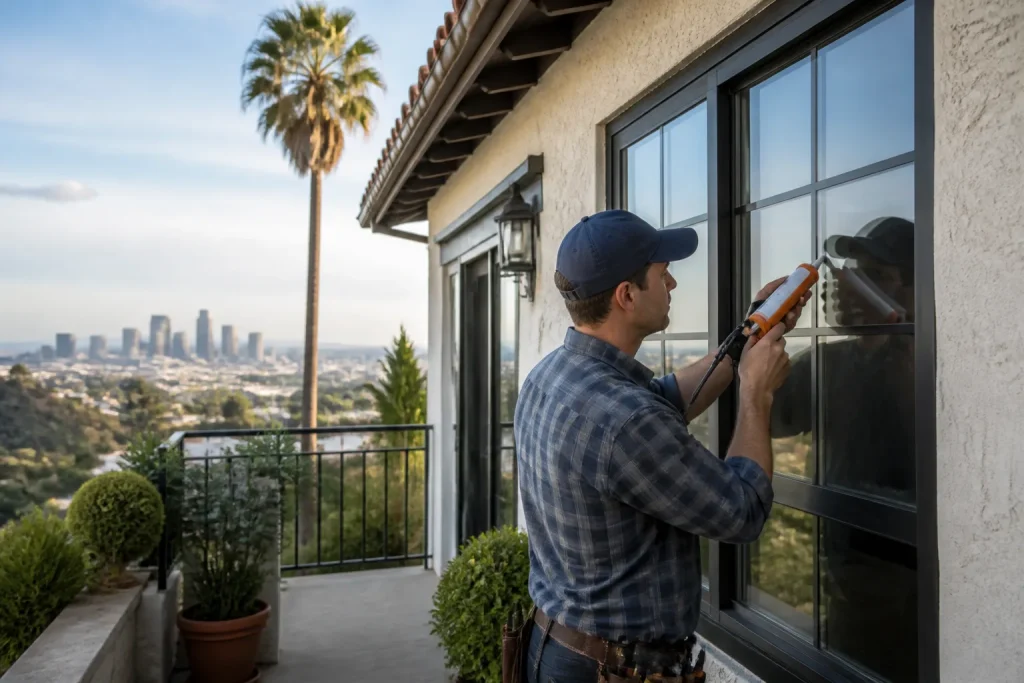
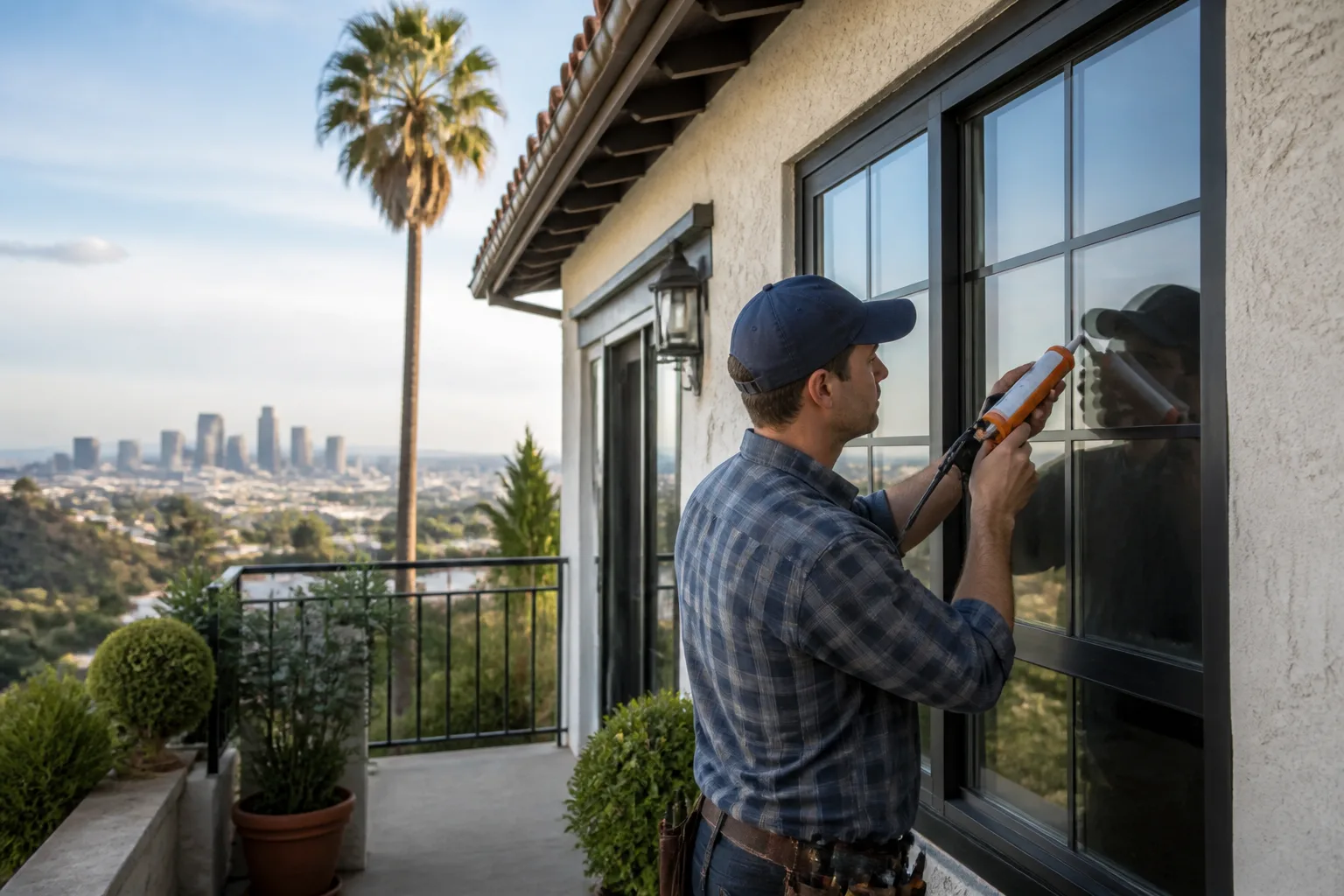
- The gap between the window frame and the stucco – not the window itself, but the perimeter where the original installer caulked. Stucco doesn’t flex. The frame doesn’t flex. But they move differently enough during thermal cycling that the caulk line eventually separates, and that hairline crack is a direct path for water to wick into the wall cavity.
- Door thresholds and sweeps – the sweep is the rubber or brush strip along the bottom of the door. On sliding doors, the interlocking weatherstrip at the meeting stile (where the two panels overlap) wears down from daily use. We pulled a sliding door out of a house in Woodland Hills last December where the homeowner had been mopping up a small puddle for two winters and thought it was just “condensation from the dog’s water bowl.” It was the weatherstrip. It had flattened to about a third of its original thickness.
- Weep holes at the bottom of window frames – small slots designed to let water drain out. When they clog with dust, spiders, or paint, water backs up inside the frame and overflows into the house. Cleaning them takes seconds with a bent paperclip.
The point is this: in Los Angeles, water damage from windows and doors is a slow leak most of the year and a sudden problem the first week of heavy rain. The dry season does not fix anything. It just hides it.
Thermal Cycling: What Warm Days and Cold Nights Do to Frames
LA’s winter temperature swings are mild compared to Minnesota, but the daily cycle of warm afternoons and cold nights still works on window frames. Vinyl expands and contracts with temperature changes. Aluminum does too, at a different rate. When a window is properly installed with room for that movement, it’s fine. When it’s installed tight or the sealant has hardened, the frame develops stress points at the corners.
What to look for in older installations:
- Vinyl windows with cracked corner welds. Vinyl frames are welded at the corners during manufacturing. Thermal stress plus age can open hairline cracks at those welds. You’ll see them first as a dark line in the corner of the sash. Water gets in, then a cold night freezes it just enough to widen the crack, and the cycle repeats.
- Aluminum windows with loose or sagging sashes. Aluminum doesn’t crack as easily as vinyl, but the thermal movement eventually loosens the screws at the sash corners. If you can wiggle the sash within the frame by more than an eighth of an inch, the hardware is wearing out and air and water are getting past it.
- Wood windows in older LA homes with peeling paint at the sill. Wood frames in neighborhoods like Pasadena, Hancock Park, and Los Feliz are beautiful but they need the paint to stay intact. When the paint fails at the bottom rail or sill, the wood absorbs moisture from winter rain and starts to rot. By the time you see soft wood, the repair is typically a full replacement rather than a repaint.
In our experience, most thermal cycling damage shows up first on the south and west sides of the house. Those faces get the strongest afternoon sun, which means the widest daily temperature swing. If you only have time to inspect a few windows, start there.
The Condensation Question: Why Double-Pane Windows Fog Between Panes in Winter
This is the one that confuses people. Condensation on the inside of the glass, the room-side surface, is normal. That’s just humidity in the house hitting a cold surface. Condensation between the two panes of a double-pane window is not normal. It means the seal around the insulating glass unit has failed, and the desiccant inside the spacer (the material that used to absorb the small amount of moisture trapped inside during manufacturing) is saturated. Once that happens, the window’s insulating value drops significantly and the fogging is permanent.
Why does seal failure show up in winter in Los Angeles? Because this is the only time of year when the temperature difference between inside and outside is large enough to pull the trapped moisture out of the air between the panes and condense it on the glass. In summer, the temperature on both sides of the glass is close enough that the condensation stays invisible. January is when failed seals announce themselves.
If you have fog between panes, the insulating glass unit needs replacement. On a window from a brand we carry like Mr-Glass or ViewLux, the frame may still be perfectly good, and a glass-only replacement is often possible. On severely aged frames, full replacement with an energy-efficient unit from a line like ECO Window Systems or PGT makes more sense. Either way, the fog is not going to clear up on its own, and ignoring it means paying higher cooling costs next summer on top of living with a window you can’t see through properly.
For more on what replacement involves and what it costs, read our Window Replacement in Los Angeles page. Most single-window replacements run roughly $400 to $1,200 installed depending on the size and product line, and you’ll have your exact written price before any work begins.
Door Weatherstripping for LA’s Mild Winters
The weatherstripping industry mostly designs products for places with real winters, where the goal is compressing a seal against sub-zero wind. In Los Angeles, you’re not fighting a -20°F draft. You’re fighting water entry at the threshold and air leakage around the door edges during rainstorms. The product you choose matters.
What we recommend for an LA entry door:
- Compression gaskets or Q-Lon foam tape – these work well in low-compression-force situations, meaning a door that closes easily and doesn’t need to be slammed. Q-Lon is a foam-filled polyethylene with a durable outer skin. It seals well, holds its shape for years, and costs about $10 to $20 for enough to do one door.
- A quality door sweep – either a U-shaped sweep that slides under the door bottom or an aluminum carrier with a vinyl insert that screws onto the face of the door. For garage-to-house doors, use a sweep with a drip cap, which sheds water away from the door rather than letting it wick underneath.
- A door shoe with a built-in drip edge – worth the upgrade on any door that faces the prevailing wind. It handles driving rain better than a simple sweep because it extends slightly beyond the door face and directs water down and away.
Skip the felt strips. They’re cheapest, they compress to nothing within a season, and they do almost nothing for water. Skip the adhesive-backed foam weatherstrip on exterior doors too – it tears, it falls off, and it’s a temporary fix at best. If you want an entry door that’s genuinely tight, a well-installed Therma-Tru door with proper weatherstripping built into the frame is hard to beat. We carry Therma-Tru among our eight manufacturer lines for exactly this reason. The weatherstripping is engineered for the specific door, not something you stick on afterward.
For more on what goes into a proper door installation, see our Door Installation in Los Angeles page.
Documenting Your Windows and Doors Before El Niño Season
Here’s something almost nobody does, and it costs people real money. If you file a water-damage claim after a winter storm, your insurance company is going to ask one question first: was the damage caused by a sudden event, or by gradual deterioration? Gradual deterioration is usually excluded. Sudden events are usually covered. The difference between those two outcomes often comes down to documentation.
Take these photos and notes now, before the rain starts:
- Photograph every window and door from the outside and inside. Use your phone. The photos don’t need to be art. They need a date stamp, which your phone adds automatically. If you have visible caulk cracks, fogged panes, or worn weatherstripping, photograph those close-up.
- Note the condition in writing. A simple note on your phone that says “November 2025: checked all windows, two small caulk cracks at master bedroom window, no water damage visible” is worth more than you’d think when an adjuster asks whether the damage pre-existed.
- Keep receipts for any caulk, weatherstripping, or minor repairs you do yourself. This shows a pattern of maintenance, which works in your favor.
- If you see water intrusion, photograph the active leak and the area immediately. Video works even better. Insurance claim departments love timestamps.
The goal isn’t to build a case against your insurer. It’s to remove ambiguity. When the photo record shows dry, intact windows in November and water damage in February, the claim is straightforward. When there’s no record, the adjuster has to guess, and the guess usually defaults to “pre-existing condition.”
If during your documentation you find something that looks like trouble – a cracked frame, fog between panes, water stains on the wall below a window – that’s the moment to consider professional help. Water problems don’t improve with time, and every winter storm makes them worse. For window installation done right the first time, see our Window Installation in Los Angeles page.
The Kingswell Way: What We Actually Do When We Show Up
When a Westlight technician comes to your home in Los Angeles for a window or door inspection, here’s the process, with no fine print. We give you a written price before any work starts. Not a verbal range, not a ballpark – a piece of paper with a number on it. We show up in the window we committed to. We leave the job site cleaner than we found it, which means a drop cloth under the work area and a broom at the end. We put the guarantee in writing. And if the work fails within the guarantee period, we come back and fix it at no charge. That’s the Westlight Windows & Doors home promise, and it’s been the same since we opened in 2009.
We answer the phone with a real person 24 hours a day, seven days a week. Not a voicemail box. Not a chatbot. If you call at 11 p.m., a human being picks up. If that human can’t answer your question, they’ll get you to someone who can.
We carry eight manufacturer lines – PGT, CGI, CWS, ES Windows, ECO Window Systems, Mr-Glass, Therma-Tru, and ViewLux – because no single brand is right for every house. A mid-century ranch in Sherman Oaks has different needs than a new build in Playa Vista, and forcing one product onto both is how you get bad installations. We match the product to the job.
The Bottom Line
Winter prep for Los Angeles windows and doors is mostly about water and seals, not insulation. Check the corner joints and perimeter caulking on older aluminum frames. Check the sweep and threshold on every exterior door. If you see fog between double-pane glass, that’s a failed seal and it’s not going to fix itself. Document everything now, before the rain season, so any insurance claim is clean and undisputed. And when you find a problem, deal with it before the first storm, because every LA winter is a gamble on whether that tiny gap becomes a puddle.
If you’re in Los Angeles and need help, Westlight Windows & Doors offers free estimates. Call (903) 354-7134 and we’ll come look at your windows and doors, tell you what needs attention and what can wait, and hand you a written price before you decide anything.
Frequently Asked Questions
Doing it yourself with caulk, weatherstripping, and a door sweep typically runs $30 to $80 per door or window, depending on how much material you need. Professional inspection and sealing of every window and door in a typical LA home usually runs $200 to $500, though the exact price depends on the age and condition of the frames and how many windows and doors you have. Call (903) 354-7134 for an exact quote – estimates are free.
Condensation on the room-side glass surface is normal humidity and typically happens on cold mornings. Fog between the two panes of a double-pane window means the insulating glass seal has failed. That fog will not clear on its own, and the window’s insulating ability is permanently reduced. A glass-only replacement is often possible if the frame is still in good condition.
If you have a failed seal, a cracked frame, or water intrusion at the corners, do not wait. Every storm that hits before the repair makes the damage worse, and water that gets into the wall cavity leads to mold and rot that are far more expensive to fix than the window itself. If your windows have minor caulk cracks or worn sweeps, those are affordable, same-visit fixes.
No. With the Kingswell Guarantee, you receive a written price before any work begins, and that price does not change at the door. If hidden damage is discovered during the project, we stop and discuss it with you, and you approve any additional work in writing before we continue. Call (903) 354-7134 for a free estimate and a written quote.
Written by Owen Satterfield, Owner at Westlight Windows & Doors, serving Los Angeles since 2009.
Need Windows & Doors Help?
Call Westlight Windows & Doors - licensed & insured, here with fast after-hours help in Los Angeles.
(903) 354-7134